Chandler Countryman
- Resilience and Adaptation Specialist
- She/her
- ccount@uw.edu
- 206.543.7347
Overview
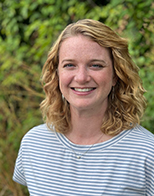
Dr. Chandler Countryman is Washington Sea Grant’s Resilience and Adaptation Specialist. In this role, Chandler works with communities across Washington’s coastlines to advance efforts related to coastal resilience by gathering local knowledge and perspectives, identifying community priorities, and connecting local efforts to funds, technical support, and other resources. She is passionate about protecting coastal environments and supporting the people who live, work, and play in these environments.
As a WSG team member, she loves combining her commitment to social justice with her passion for research, education, and outreach. She has been active in diversity, equity, inclusion, justice, and accessibility efforts in her previous roles and continues to center these values in her work at WSG, especially through support for underserved and underrepresented communities.
In her role, she engages with local government, state and federal agencies, environmental restoration groups, ecological researchers, community organizations and residents, local businesses and industries, Tribes and Tribal organizations, coastal engineers, and other relevant practitioners.
Chandler currently has four main components of her work portfolio at Washington Sea Grant:
- She co-manages the Coastal Hazards Resilience Network (CHRN), which is a statewide network of coastal resilience practitioners with a website that provides a curated selection of relevant science, best practices, and other resources related to coastal hazards in Washington.
- She supports outreach and sustained engagement efforts to users of the United States Geological Survey (USGS) Coastal Storm Modeling System (CoSMoS) in Washington State, which is a tool that helps planners understand their risk and vulnerability to compound flooding (sea level rise, high tides, coastal storms, and rainfall) on the coast.
- She supports climate resilience in coastal communities in southwest Washington through public workshops and projects that reduce flooding, improve water quality, and/or restore habitats.
- Current efforts are underway in the Lower Willapa region
- Completed projects and related reports are available for the Lower Columbia River region
- She runs the Washington King Tides Program, which offers a King Tides Calendar and other resources to learn about King Tides in Washington. This program also includes a series of public events in the form of King Tides Viewing Parties and the use of the MyCoast App to report King Tides and associated flooding.
- She supports the climate readiness of Northwest coastal Tribes. Current projects and recent work includes:
- Olympic Coast Ocean Acidification Regional Vulnerability Assessment (RVA) Phase 2: this project will produce new guidance tools and products to inform ocean change adaptation resilience, and mitigation planning by the Coastal Treaty Tribes of WA and other Olympic Coast marine resource users and managers.This is phase 2 of the previous Ocean Acidification RVA efforts.
- The Tribal Coastal Resilience Portfolio of the Northwest Climate Resilience Collaborative (A NOAA RISA Program) 2024 Report: Climate Adaptation Barriers and Needs Experienced by Northwest Coastal Tribes: Key Findings from Tribal Listening Sessions.
Expertise
- Community and Ecosystem Resilience
- Coastal Hazards and Climate Change Adaptation
- Science Communication and Education
- Facilitation and Project Management
- Community Engagement and Outreach
- Marine Sciences and Oceanography
Before joining WSG, Chandler was a 2022 Knauss Marine Policy Fellow, placed in the U.S. House of Representatives in Washington, D.C., where she worked on national-level climate and environmental policy, with a focus on incorporating support for Nature-based Solutions and environmental justice considerations into federal policy. She has run environmental science camps and marine conservation courses for K-12 students, in addition to field courses for undergraduate students in coastal oceanography on Sapelo Island–a small barrier island off the coast of Georgia. Chandler’s passion for coastal and community resiliency was ignited by her years spent teaching, living, and engaging with residents on Sapelo Island, many of whom are part of the Gullah Geechee community.
Chandler was the first person in her family to go to college and was supported through the Federal Pell Grant, academic scholarships, work study opportunities, and the McNair Scholars program. She is passionate about supporting and mentoring underrepresented students of all ages as they navigate their desired career path. She holds a Bachelor’s degree in Biology from Northern Michigan University and a Ph.D. in Marine Sciences from the University of Georgia. Her graduate research was part of the NASA EXPORTS project and focused on the ocean’s role in the global carbon cycle. New to the PNW, Chandler enjoys reading, exploring tidepools, roller derby, and any chance to get out on a boat.