
Legacy and Emerging Contaminants in Seaweeds of Interest for Washington State Aquaculture Development
Principal Investigator
- Ruth Sofield, Western Washington University, ruth.sofield@wwu.edu
There is growing interest in farming seaweed for human consumption. Yet seaweed farming at scale is new to Washington state, and seaweeds have been shown to accumulate contaminants at levels that can be harmful to human health. Further, little research has focused on how “forever chemicals” such as per- and polyfluoroalkyl substances (PFAS) may accumulate in seaweed. Marine farmers and harvesters in Washington need information about contaminants in seaweeds to effectively manage seaweed aquaculture operations.
Project background
This project’s overall goal is to measure legacy (PCBs, arsenic, cadmium, lead, and mercury) and emerging (per- and polyfluoroalkyl substances (PFAS)) contaminants in seaweeds currently or likely to be grown and harvested in Washington’s marine waters. Although the state’s seaweed aquaculture industry is small, there is substantial interest at both federal and state levels in furthering its development. This project’s research plan was developed in consultation with a local seaweed operation and addresses knowledge gaps in the risks contaminants pose to consumers, which could affect the industry’s development. The results will guide current and developing operations on selecting new aquaculture species and developing harvesting practices that minimize risks to end-users of seaweed products.
Results and findings
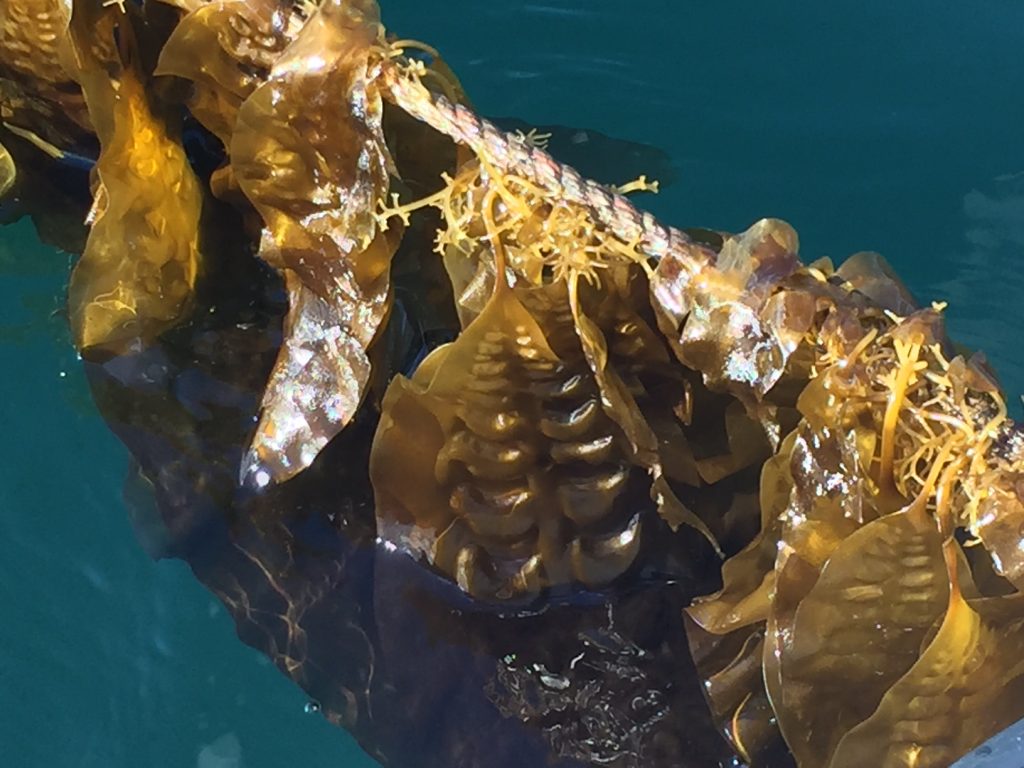
The research team analyzed how concentrations of contaminants of concern vary seasonally and inter-annually, spatially and among seaweed species. They also investigated the potential for passive water samplers to predict the amounts of contaminants that will accumulate in farmed kelps. The researchers processed more than 400 seaweed samples and analyzed them for 21 metals, 209 PCBs, and “forever chemicals.” Based on a suggestion from a representative at the Washington Department of Health, they also conducted experiments with bull kelp to determine whether rinsing seaweed before eating would change PFAS concentrations. Preliminary results showed that the three main groups of seaweed – reds, greens, and browns – take up contaminants differently, with reds in particular taking up more PCBs than greens and browns, and metal uptake varying across seaweeds. The rinsing technique was unsuccessful in removing PFAS, as it changed the seaweed structure so the seaweed was no longer edible. The researchers found that in general, the data does not show trends in seaweed contaminants that raise concerns about seaweed harvest or aquaculture as long as the sites themselves are not contaminated beyond background levels. As an outreach component of the project, the team developed lesson plans about seaweed with the Swinomish Tribe and K–12 teachers.
Contact information
Ruth Sofield
Professor
Western Washington University
360.650.2181
Ruth.Sofield@wwu.edu