
WASI Case Study: Toray Composite Materials America, Inc.
Point of Contact
Deborah, dpurce@uw.edu
Description
This Washington Applied Sustainability Internship (WASI) involved three projects:
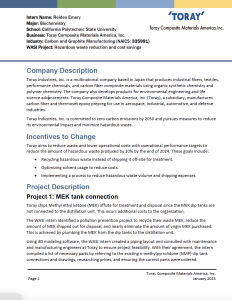
Project 1: MEK tank connection
Toray ships Methyl ethyl ketone (MEK) offsite for treatment and disposal since the MEK dip tanks are not connected to the distillation unit. This incurs additional costs to the organization.
The WASI intern identified a pollution prevention project to recycle their waste MEK, reduce the amount of MEK shipped out for disposal, and nearly eliminate the amount of virgin MEK purchased. This is achieved by plumbing the MEK from the dip tanks to the distillation unit.
Using 3D modeling software, the WASI intern created a piping layout and consulted with maintenance and manufacturing engineers at Toray to ensure project feasibility. With their agreement, the intern compiled a list of necessary parts by referring to the existing n-methylpyrrolidone (NMP) dip tank connections and drawings, researching prices, and ensuring the correct parts were ordered.
Project 2: Solvent usability testing
The WASI intern established an easy test to determine the usability of the solvent in the dip tanks and to establish a solvent replacement schedule based on need.
- Both the MEK and NMP dip tanks were flushed and replaced every two weeks for ease of operation.
- The testing and analysis focused on the NMP tanks which became dirty more quickly.
The test measured the specific gravity of the solvent at various resin saturations, using the most difficult resin to dissolve. Measurements were taken at the operating temperature of the tanks to ensure easy replication for technicians. The WASI intern found that measuring specific gravity could be a viable option for measuring the usability of wash tanks, but further testing is required.
Project 3: Compacting hazardous waste
The WASI intern compiled data to determine if a compactor would reduce the cost of hazardous waste disposal. They looked at:
- Current waste accumulation.
- Shipping and disposal costs, and projections.
The cost-benefit analyses conclude that purchasing a compactor is the best course of action for reducing costs.