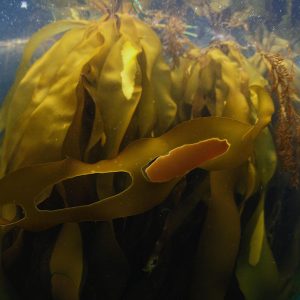
Diving into “The Mysterious World of Bull Kelp”
From the Summer 2026 Sea Star
A cluster of elongate olive-brown tubes floats on the surface waters off the North Pacific Coast. Each has a head-like bulb at one end topped with a flourish of thin sinewy blades, almost resembling hair.
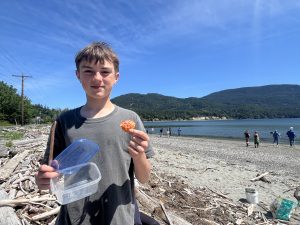
First detections of highly invasive European green crab on Orcas Island
Students from Orcas Island Middle School discover green crab molt while on a field trip
Orcas Island, WA — Evidence of invasive European green crab was detected for the first time on Orcas Island in May, when a Washington Sea Grant (WSG) Crab Team volunteer monitor and science teacher Amy Sprenger reported one of the distinctive five-pointed shells on Crescent Beach in Eastsound.
Removing the barriers to salmon recovery
A new tool weighs the multifaceted factors involved in efforts to improve habitat
From the Summer 2025 Sea Star
By Brian McGreal, WSG Science Communications Fellow
In 2018, in a case brought forth by 21 Northwest Tribes, the Supreme Court ruled that Washington State has a duty to protect tribal treaty rights by preserving fish runs.
The Salmon and Climate Initiative brings a broader perspective to recovery efforts
From the Summer 2025 Sea Star
By Jess Davis, WSG Science Communications Fellow
Big actions often start with simple dreams. Nearly 40 years ago, many Washington state salmon fishermen began noticing declining stocks in salmon populations.
More than just a cute face: What otters can tell us about the health of the environment
The River Otter Project used community science to shed light on contamination in the Lower Duwamish River
By Andrea Richter-Sanchez, WSG Science Communications Fellow
“Otters are an easy way to engage people to care about the environment.
Monitoring the Damage in the Heat Wave’s Wake
Washington Sea Grant rapidly provided funding to two projects to survey the impacts of the historic June 2021 heat wave on intertidal marine life
From the Autumn 2022 Sea Star
In June 2021, the peak of an unprecedented heat wave coincided with extremely low tides in the Salish Sea, wreaking havoc on intertidal ecosystems.
New harmful algal bloom research and monitoring initiative will focus on recently-identified culprits behind shellfish mortality events
With funding from the NOAA National Centers for Coastal Ocean Science, researchers from Washington Sea Grant, the Northwest Indian College and Washington Department of Fish and Wildlife will study shellfish-killing toxins
Over the last few decades, shellfish farms and natural shellfish populations in Washington State have suffered large losses due to blooms of harmful algae that are not traditionally monitored and whose toxic effects are poorly understood.