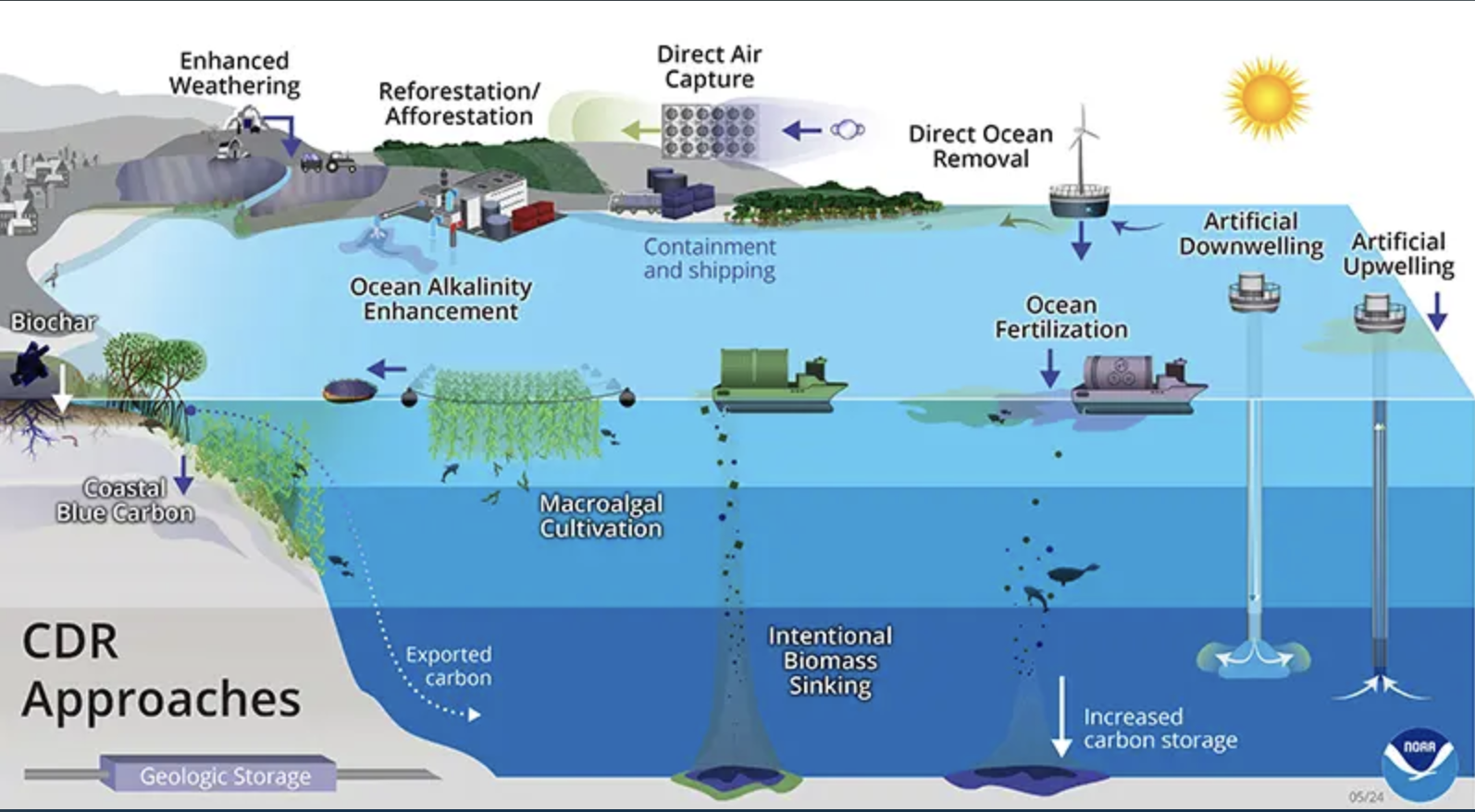
The increase of carbon dioxide (CO2) in the atmosphere has led to warmer surface temperatures on land and in global oceans, ocean waters becoming more corrosive and lower in oxygen, changes in marine food webs, and other impacts. Removing carbon from the atmosphere, or carbon dioxide removal (CDR), could be an important way to avoid the worst effects of our changing environment in this century, and help restore balance in the longer term. Marine carbon dioxide removal, or mCDR, uses the ocean’s inherent carbon-capturing capacity to help us recover and safely store carbon dioxide from the atmosphere. As researchers, governments and communities evaluate the potential of mCDR, they are exploring a variety of methods and approaches.
The technology behind mCDR is still in its early stages. While research and development progresses, there have been few open-water trials to date. However, some of the earliest experiments and pilot projects have taken place in Washington state. Between expertise at NOAA’s Pacific Marine Environmental Laboratory, Pacific Northwest National Laboratory, and the University of Washington, Washington state has the potential to become a global mCDR hub.
WSG has a two-fold role in this space: first, supporting informed decision-making about the trajectory of mCDR in our region, and second, providing opportunities for diverse mCDR constituents to share knowledge, discuss research and community priorities, and chart a course for responsible research and development in the Salish Sea, the Straits of Juan de Fuca, and along the Pacific coast.
Community building and outreach
Pacific Northwest mCDR Node
The Pacific Northwest mCDR Node is one of five regional nodes launched by the Ocean Carbon & Biogeochemistry program to bridge scientific research and public benefit at the local and regional level. WSG carbon specialist Meg Chadsey leads the Pacific Northwest mCDR node, tailoring mCDR activities and discussions to PNW-specific marine environments, regional challenges, rightsholder and stakeholder groups.
British Columbia/Washington mCDR Community of Exploration
The BC/WA Community of Exploration is dedicated to exploring responsible, inclusive, and evidence-based mCDR. It focuses on British Columbia and Washington state, reflecting the interconnected nature of our coastal ocean ecosystems, shared governance responsibilities, and regional climate goals. The Community of Exploration serves as a trusted forum for coordinated research, knowledge mobilization and co-production, and policy engagement.
WSG workshops
- Catalytic mCDR Community Building in the Pacific Northwest: a three-part workshop series sponsored by the ClimateWorks Foundation to explore the question “What should responsible mCDR research and development in the Salish Sea & Straits of Juan de Fuca look like?”
- Workshop 1: April 21, 2026, Port Angeles, WA
- Workshop 2: July 14, 2026, Seattle, WA
- Workshop 3: September 2026 (date TBD), Seattle, WA
- Advancing Community-informed mCDR Modeling in the Salish Sea & Straits of Juan de Fuca
- Workshop: July 15, Seattle, WA
WSG outreach
WSG staff engage in outreach activities around mCDR including webinar series and podcasts, as well as contribute to mCDR research.
- West Coast Conversations on Carbon: a regional mcDR webinar series coordinated by the Pacific Coast mCDR Collective
- PlanSea Podcast – Insights from the 2025 Ocean Visions Summit
- ‘Sea Grant’s Role in Marine Carbon Dioxide Removal’ – Sea Grant Law and Policy Journal (expected publication: Summer 2026)
Marine Carbon Dioxide Removal Fellow
WSG launched a fellowship in partnership with Banyu Carbon in 2026. The fellowship focuses on advancing responsible marine carbon dioxide removal (mCDR) in the Salish Sea by ensuring that scientific models used to track and verify carbon removal are informed by the people most affected by them.
Contact
Meg Chadsey, WSG carbon specialist: mchadsey@uw.edu
Mariah Ricci, WSG mCDR Fellow: maricci@uw.edu
WSG Carbon: WSGcarbon@uw.edu