Impacts of floating oyster aquaculture on coastal sediment dynamics in Willapa Bay, WA
Principal Investigator
- Kendall Valentine, University of Washington, kvalent@uw.edu
Co-Principal Investigator
- Christie Hegermiller, University of Washington, caheg@uw.edu
The use of flip-bags, a floating aquaculture method, holds potential to reduce challenging farming conditions that have worsened in Willapa Bay, Washington. At the same time, flip-bags could impact the surrounding water and sediment dynamics in ways that are currently unknown. This project has three primary goals: 1) quantitatively evaluate a relatively underused oyster aquaculture method in Willapa Bay that may mitigate the effects of burrowing shrimp and other environmental changes, increasing the resilience of regional economy and heritage; 2) identify the radius of impact of flip-bags to develop conscientious planning for deployment of this farming method; 3) evaluate potential co-benefits of floating oyster aquaculture, such as carbon capture due to increased sedimentation or erosion mitigation through wave dissipation.
Project background
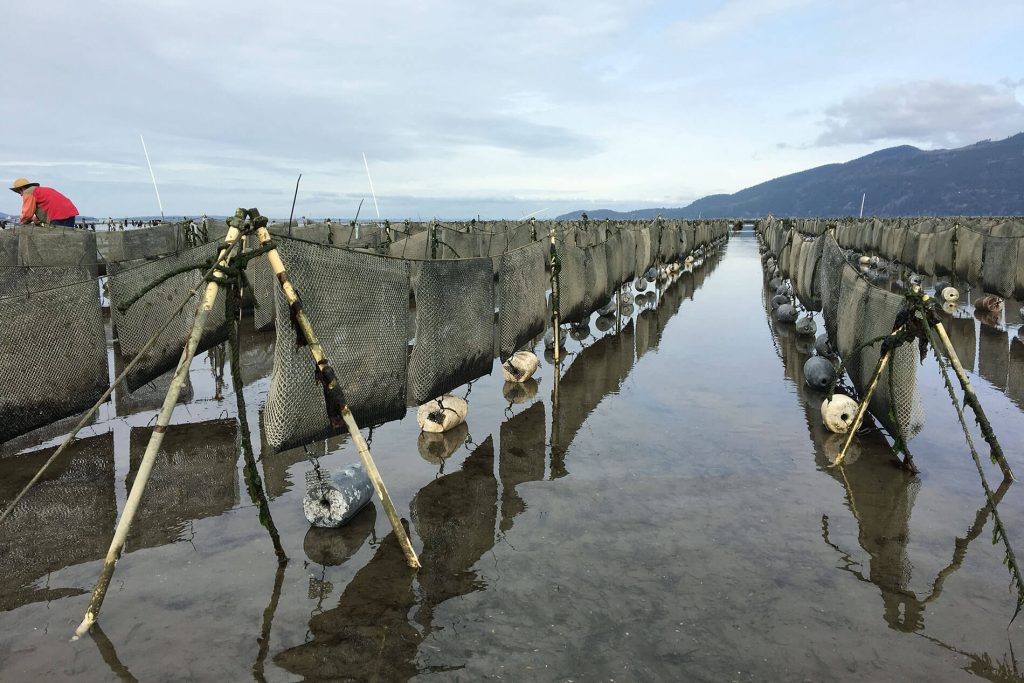
The coastal estuaries of Willapa Bay and Grays Harbor, along the southwest Washington coast, are major producers of oyster aquaculture and have been for generations. However, a drastic increase in burrowing shrimp populations and changing morphology of the bays have destabilized the bed sediments where oysters have been historically grown and harvested, making it difficult for oyster growers to maintain their businesses and ways of life. Recently, oyster farms have started to deploy floating flip-bags as an alternative farming method that may help to maintain bed productivity despite changing sediment conditions. The effects of these floating structures on coastal dynamics (i.e. currents, waves, sediment transport) remain unknown.
Results and findings
This project will use two primary methods to investigate the effects of flip bag aquaculture: field observations and numerical modeling. Field observations will measure hydrodynamics and sediment transport near floating oyster bag sites, as well as collect data for model parameters and validation. Model simulations will then quantify the hydrodynamics and sediment transport at bag sites, evaluate the radius of impact from flip-bag infrastructure, and clarify the range of effects for different flip-bag configurations.. The research team will engage with the local oyster farming community throughout the process in partnership with the Pacific Conservation District, the Willapa-Grays Harbor Estuary Collaborative, and Washington Sea Grant.
Contact information
Kendall Valentine
Assistant Professor
School of Oceanography, University of Washington
kvalent@uw.edu
Photo courtesy of Northwest Fisheries Science Center