Remembering David George Gordon
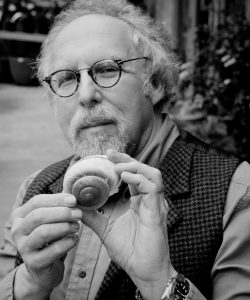
With heavy hearts, we share the news of the passing of author, speaker and former Washington Sea Grant staff member David George Gordon. He died in early August in Tacoma, Washington, after complications due to a fall. He was 76 years old.
Gordon had a long and illustrious career as a writer dedicated to “singing the praises of nature,” including serving as science writer at WSG from 1998–2012. He was the author of 22 books — perhaps most famously The Eat-a-Bug Cookbook, after which he spent several decades touring the country and the world as “The Bug Chef.”
While at WSG, Gordon helped countless people better understand Washington’s marine and coastal ecosystems, and played a pivotal role in shaping how the outside world sees the organization. Many of his initiatives — and even turns of phrase — persist at WSG today. Along with former WSG communications manager Nancy Blanton and former graphic designer Robyn Ricks, he launched Sea Star magazine, and he authored many of its articles. He also launched the WSG Science Communications Fellowship, through which he mentored many students. Most of all, his colleagues remember his quick quips, spark, humor and dedication to the written word.
He was also lead author of Heaven on the Half Shell, a book that tells the story of the oyster in the Pacific Northwest, first published in 2001. This book came together when Bruce Brenner of the J. J. Oyster Company shared the scrapbooks of his father, Earl Brenner, which chronicled decades of oyster farming in Washington. Not wanting this history to be lost to time, Gordon wove together the anecdotes from the scrapbook and other historical documents in the book. He worked with Nancy Blanton and Terry Nosho, former WSG aquaculture specialist. The book was designed by Robyn Ricks.
Two decades later, David Gordon approached WSG again about working on a new edition of Heaven on the Half Shell. On a personal note, I was now in the role of WSG science writer, and was delighted when my office phone rang and it was David on the other end. He asked whether I would be interested in collaborating with him on updating and expanding the book, making the argument that a lot had happened in oyster cultivation over the past twenty years, and there were opportunities to dig deeper into some of the topics in the first edition.
I was already familiar with David’s work, and with the original Heaven on the Half Shell. In fact, by that time we’d had several intersections, all of which made an impression on me. I first met David when I was an editorial fellow at the online environmental magazine Grist, and he came to our office as “The Bug Chef” to give a cooking demonstration. I was struck by his ability to balance the whimsical, weird and fun — “Yuck! Cricket risotto!” — with serious topics — such as that reconsidering what we put on our plates could go a long way to addressing some of our most pressing environmental challenges.
Not long after, I was volunteering at the Seattle Aquarium at a display featuring local phytoplankton, and David happened to be there. I recognized him as The Bug Chef but, at that time, he would have no reason to know who I was. He came up, twinkle in his eye, eager to talk about these amazing microscopic critters. In the 1980s, before he became a science writer, he worked at the Shedd Aquarium in his hometown of Chicago and, later, Point Defiance Zoo and Aquarium in Tacoma. His ongoing curiosity about and passion for marine life was obvious.
I next encountered David when I was working as a freelance writer, and The Seattle Weekly gave me an assignment to cover his new book, The Sasquatch Seeker’s Field Manual, which uses the premise of looking for Bigfoot to teach community science methods. “So, do you really think that Sasquatch is out there?” I asked. He wouldn’t say. I can’t say for sure but, through the phone, I thought I could hear the transmission of an eyewink. To me, the book’s pages demonstrated David’s ability to use a playful tone while keeping a reverence for life’s greatest mysteries, including the ones that science had yet to uncover.
I later took an assignment for Crosscut to write a series about the oyster industry in Washington — and the first edition of Heaven on the Half Shell served as one of my main resources. As someone who loves to eat oysters but hadn’t thought much about what goes into producing them, my mind was blown by the nuances and complexities of the trade. When I came across the job opportunity of science writer at WSG, knowing that David had previously held the role, and that he worked on projects such as Heaven on the Half Shell, was an inspiration behind my application.
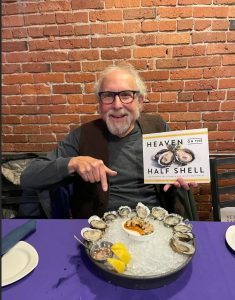
Along with co-author MaryAnn Wagner, former WSG assistant director for communications, we published the second edition of Heaven on the Half Shell in partnership with University of Washington Press in 2023. It was an honor to work closely with David on the book. At one point, David commented that he almost felt like he had written some of the new sections I had penned; something I continue to take as the highest compliment.
It was also an honor to participate in taking Heaven on the Half Shell on tour, presenting the book at events in Seattle, the Washington coast, and beyond. David was a gifted speaker who easily engaged audiences as he riffed on oyster anecdotes and his favorite pieces of their history. Even after our book tour, David continued sharing the book through his role as a speaker with Humanities Washington, through which he also spoke about topics from his other books, including slugs and snails.
Most of all, David will be remembered for his big heart, zest for life, sense of humor, and love of the natural world — perhaps especially its lesser-considered or more controversial denizens.
David is survived by his wife of 17 years, the painter and illustrator Karen Luke Fildes (whose illustrations grace David’s revised Eat-a-Bug Cookbook and The Secret World of Slugs and Snails), six children, and four grandchildren.
A celebration of his life is planned for November 8 in Tacoma. For event information, please reach out through his website.