
Collaborative Science and Modeling to Understand Processes Affecting Dungeness Crab Recruitment in the Salish Sea
Principal Investigator
- P. Sean McDonald, University of Washington, psean@uw.edu
Co-Principal Investigators
- Karen Chan, University of Washington, kychan@uw.edu
- Emily Buckner, Puget Sound Restoration Fund, emily@restorationfund.org
- Tarang Khangaonkar, University of Washington, ccook91@uw.edu
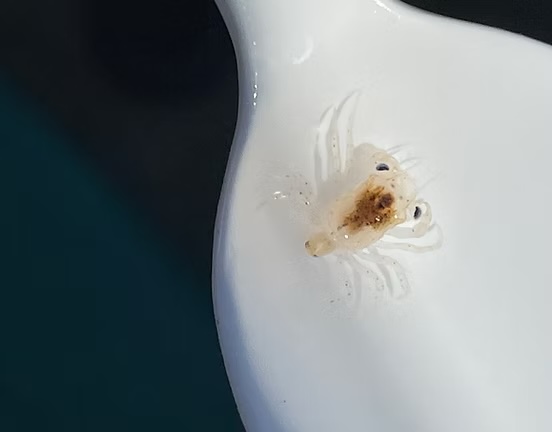
This project aims to address knowledge gaps in Dungeness crab recruitment dynamics to support climate adaptive and equitable management of Dungeness crab fisheries. The project’s short term goals are to: 1) quantify the abundance, size, and behavior of late-stage Dungeness crab larvae (megalopae) across a collaborative monitoring network; 2) use lab-based video tracking to evaluate larval swimming behaviors under varying temperatures; and 3) couple data with the Salish Sea Model and the Ichthyop particle tracking model to simulate larval dispersal and environmental exposure under current and future climate conditions. Long term, this research will identify source-sink dynamics and provide fisheries managers with predictive tools to better anticipate recruitment variability and potential collapse risks.
Project background
Dungeness crabs are a vital species ecologically, economically, and culturally in the Pacific Northwest. In the marine food web, they serve as prey for endangered salmon populations and other species. Dungeness crabs are important to Indigenous communities and support one of the region’s largest commercial and recreational fisheries. Despite their importance, there is a persistent lack of information on Dungeness crab early life history stages that could be used to assess recruitment and the impacts of habitat quality or changing environmental conditions. In the last decade sharp declines in harvestable crab in South Puget Sound and Hood Canal have led to the closure of tribal and state recreational fisheries. The drivers of this population decline remain uncertain. A better understanding of Dungeness crab larval dispersal and recruitment in Washington’s inland waters will lead to better workforce training and more sustainable management.
Results and findings
The project will integrate field monitoring, laboratory experiments, and modeling to investigate Dungeness crab larval dispersal and recruitment. The team will leverage an existing network of 18 larval light trap locations around Washington, taking samples from April to September. Megalopae will be measured and subsampled to characterize cohort structure and patterns in abundance, and samples will be paired with temperature loggers to assess environmental conditions. Lab observations will use non-invasive video tracking to evaluate behavioral responses to temperature, with tracking software measuring swimming speeds, vertical positioning, and behavioral changes under light/dark conditions. Finally, modeling will simulate larval dispersal to explore larval transport, environmental exposures (temperature, oxygen), and recruitment under present and future climate conditions.
Contact information
P. Sean McDonald
Associate Teaching Professor
Program on the Environment, University of Washington
206.616.2186
psean@uw.edu
Photo courtesy of Pacific Northwest Crab Research Group