
Cultivating a sustainable future for basket cockles and tribal communities: restoring access to a preferred traditional First Food
Principal Investigator
- Elizabeth Unsell, Suquamish Tribe, eunsell@suquamish.nsn.us
Co-Principal Investigators
- Ryan Crim, Puget Sound Restoration Fund, ryan@restorationfund.org
- James Dimond, Puget Sound Restoration Fund, jay@restorationfund.org
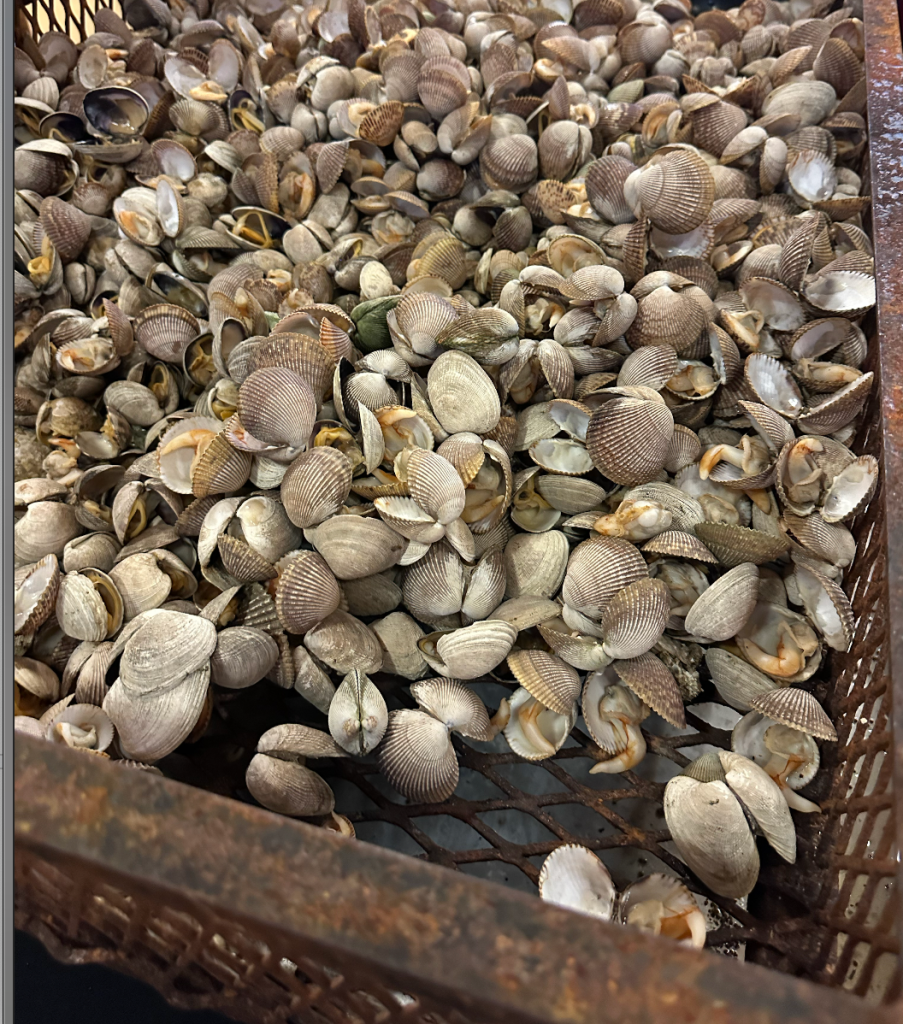
Basket cockles are a favored traditional food for Suquamish Tribal members. In recent decades, populations on local subsistence beaches have been lower than historically observed, making it challenging for Tribal members to harvest cockles for their families. Recruitment and/or survival is unreliable, and there is therefore a need to identify ways to enhance local cockle populations in a responsible manner. This project aims to advance sustainable hatchery production techniques by exploring breeding strategies that maximize genetic diversity.
Project background
Basket cockles are a favored traditional food for Suquamish Tribal members. Over the last couple of decades, populations on local subsistence beaches have been lower than historically observed, making it challenging for Tribal members to harvest cockles for their families. Recruitment and/or survival is unreliable and we therefore need to identify ways to enhance local cockle populations in a responsible manner. Having found little genetic variation in the wild cockle genetics of Puget Sound, with the exception of Hood Canal, researchers now know that transferring cockles from one area to another should pose a low to nonexistent risk of impacting genetic diversity. Now there is a need to test these concepts out in reality. The team expects to learn whether collecting and transferring wild cockle recruits from geoduck tubes to beaches is feasible, and which strategies result in the greatest survival and growth rates.
Results and findings
This project aims to advance sustainable hatchery production techniques by exploring breeding strategies that maximize genetic diversity. Researchers will conduct two rounds of genetic analysis. The first will compare samples from cockles produced in the hatchery in 2019 to existing wild cockle genetic data. The second will compare wild broodstock with their hatchery produced offspring as well as the wild genetic data set. The success of different seeding strategies will be evaluated. This will include collecting juvenile cockles from geoduck tubes and using cockles produced in the hatchery to transfer to experimental plots on Suquamish beaches, and then comparing growth and survival under different treatments. The primary long term goal and motivating factor for this project is to enhance cockle densities on local subsistence beaches without negatively impacting the genetic diversity of wild cockle populations.
Contact information
Elizabeth Unsell
Shellfish Biologist
Suquamish Fisheries Department
360.271.1055
eunsell@suquamish.nsn.us