
Two-eyed seeing in practice: Participatory modeling to evaluate pinniped hunting in Puget Sound as a tool for salmon recovery
Principal Investigator
- Jonathan Scordino, Makah Tribe, jonathan.scordino@makah.com
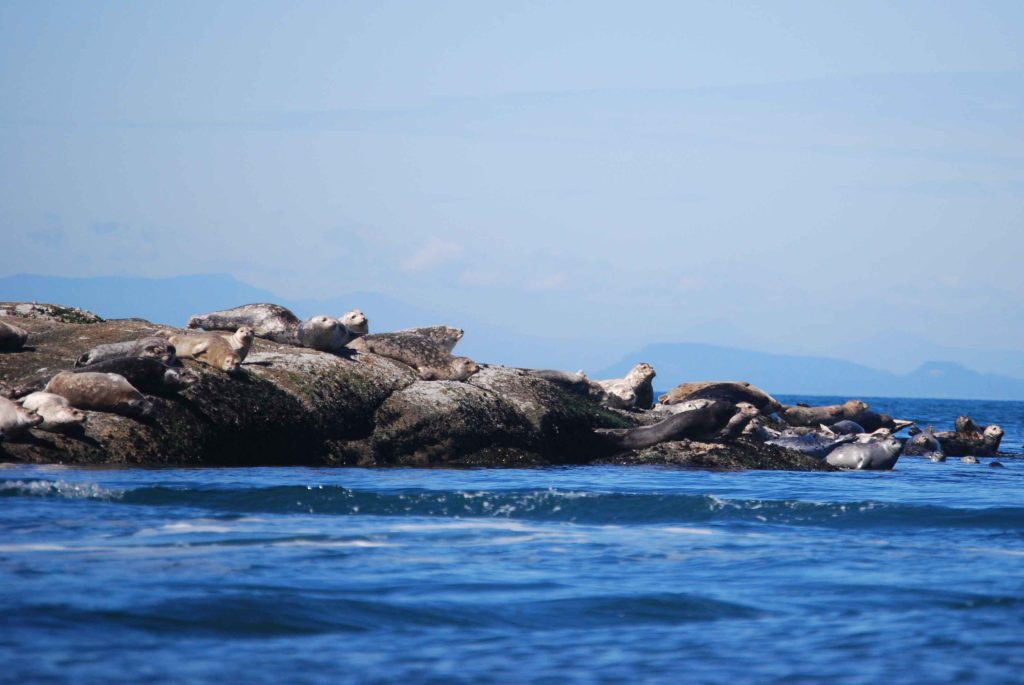
This project aimed to use participatory modeling informed by the principles of two-eyed seeing to bridge Indigenous and Western knowledge sources to evaluate the benefits and risks of tribal pinniped management options in Puget Sound, with the aim of salmon recovery. The three research objectives were: 1) build a model ensemble that evaluate the impacts of pinniped management scenarios; 2) conduct a participatory approach using two-eyed seeing to identify modeling parameters and uncertainties and ensure usefulness in management frameworks; 3) develop scenarios that enable tribes to manage a cultural resource, maintain pinniped populations long-term, and adapt to management challenges.
Project background
Increasing pinniped predation is a factor in declining salmon survival in Puget Sound. Reducing predation risk in key habitat areas and migration corridors may be a viable management strategy in the recovery of protected salmon species. Learning more about the impacts of pinniped feeding behaviors and how to deter or reduce pinniped predation will help state and Tribal managers and harvesters create better management plans to aid in salmon recovery.
Results and findings
In collaboration with Tribes, Washington Sea Grant-funded researchers completed a modeling tool that incorporates pinniped learned predation behavior, the abundance of pinnipeds in an area, and the impacts pinnipeds have on salmon in key migration areas. Managers can use the tool to explore responses that alter the relationship between pinnipeds and salmon in these “gauntlet” areas, where salmon face many threats and it is easier for pinnipeds to prey on them. The team applied the tool to two case study gauntlet areas with two different Tribes in Puget Sound: the Nisqually River, with the Nisqually Tribe, and at Seattle’s Ballard Locks with the Muckleshoot Tribe. Presenting preliminary modeled results from management options for both case studies resulted in requests to implement the tool elsewhere in Puget Sound and to look at juvenile salmon predation within the case study areas. With the tool soon to be publicly available, interest from multiple other tribes working on salmon recovery is strong.
Contact information
Jonathan Scordino
Marine Mammal Biologist
Makah Tribe
jonathan.scordino@makah.com