
A rough road to recovery for Puget Sound rockfish
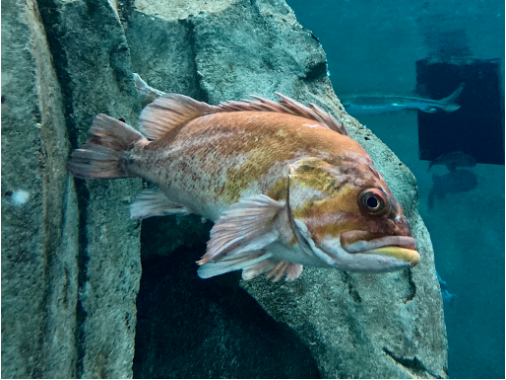
Imagine you are out on the emerald waters of Puget Sound. The sun is bright, the wind is calm, your fishing rod is in place, and you are just waiting for that bite. A tug on the rod and you pull up a two-and-a-half-foot-long rockfish, a prize worth its sizable weight in gold. You bring it home, and it feeds your family for multiple meals.
While once a possibility, unfortunately this reality is no longer. Rockfish fisheries were closed in the 1980s (commercial, Washington-wide) and 2010 (recreational, Puget Sound) due to overfishing and severely declining populations. While rockfish populations along the Pacific coast and Strait of Juan de Fuca appear to be recovering, Puget Sound rockfish are not.
While “rockfish” as a group are found throughout Washington waters, the many species and different life history patterns complicate management practices. Supported by Washington Sea Grant funding, Dr. Lorenz Hauser and his lab at the University of Washington have been untangling the genetic web of Puget Sound rockfish to better understand interactions between Pacific coast and Puget Sound populations, as well as pathways to improve species recovery. Their research demonstrates that rather than managing Puget Sound rockfish as a group, recovery may need to occur on a species-by-species basis. By unveiling the varied population structure, this research can be used to determine management strategies for the recovery of individual species.
Rockfish biology and ecology
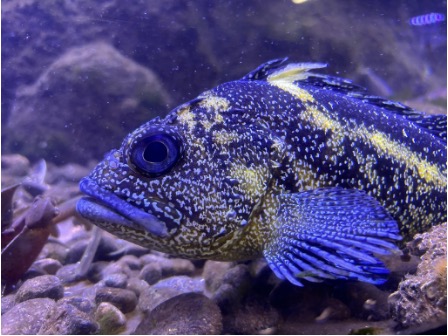
Washington’s 32 rockfish species are classified in the genus Sebastes, which translates from Greek to “magnificent.” Rockfish can be identified by the sharp spines along their heads and fins, the latter of which contain a mild venom as a predator defense mechanism. In contrast to most fishes, rockfishes are live-bearing. Larger females produce higher numbers of nearly-microscopic larvae (sometimes more than 1 million per year), so population management often focuses on preserving these larger individuals.
Within Puget Sound, rockfish populations are often difficult to estimate. With the fisheries closed, population monitoring is limited to annual ROV surveys by Washington Department of Fish & Wildlife (WDFW). Not only do the rockfish species of Puget Sound look similar, but copper, quillback, and brown rockfish also hybridize within the Puget Sound region. Hybridization occurs when two individuals of different species produce offspring together, making it more difficult to assess which fish is which species. This discovery is not new; former UW faculty Dr. Lisa Seeb uncovered Puget Sound rockfish hybridization in the 1980s. Ten years ago, Piper Schwenke, then a student in the Hauser lab, estimated that 40% of the copper, quillback, and brown rockfish samples tested were hybrid individuals. Hauser’s current project grew from that research; using new technologies to sequence entire genomes better reveals the relationships between rockfish species, and in turn, how to support those species that aren’t doing as well as others.
The work so far
Hauser and his team relied on archived tissue samples to collect their data. The lab had two resourceful graduate students working on these topics for their theses: Anita Wray (UW M.S., ‘22) and Liz Boggs (UW M.S., ‘26). Wray and Boggs both focused on using rockfish genetics to determine how rockfish populations operate within Puget Sound. “Part of the novelty of this work was that a master’s project was enough [time] to work on eight species,” Hauser says. “Ten years ago, we could not have done that, so it was really quite exciting to see that with the new technology we can do a lot of work.”
An ambitious undertaking all around, the research could not have moved forward without the collaborations with Washington Department of Fish and Wildlife, NOAA, and Department of Fisheries and Oceans Canada (DFO), with additional funding from SeaDoc Society and other organizations. “It was great to collaborate with all the agencies. They were all happy to share their samples and expertise,” Hauser says. Collaborators shared preserved fin clips with the Hauser lab from eight species. Once organized, DNA from the fin clips were extracted and sequenced. The students then compared the sequences against one another in order to determine their relatedness: within species, between species, and geographically across the region.
Understanding population structure in rockfish species
Two masters’ theses and several published scientific papers later, we now have a better understanding of rockfish populations throughout the Salish Sea. There are gene-level differences that, when sequenced, show the relationships between individuals, populations, and species. When collated, these relationships tell researchers whether there is a particular population structure. An unstructured population means that fish are equally related throughout their range, and that fish are likely traveling between parts of the Salish Sea, which can help spread and increase genetic diversity in the population. Population structure indicates isolated groups or limited movement between geographic areas – both barriers to recovery.
As part of Wray’s work, she found that black and Puget Sound rockfishes show no population structure. Of all the species tested, black rockfish are pelagic throughout their lives, and are often found in the water column in kelp forests, near piers and jetties, and other vertical structures. A mobile species could easily lead to a mixed, unstructured population throughout the region. Yellowtail, greenstripe, and redstripe rockfish did show structured populations, but for varying reasons. Yellowtail and greenstripe rockfish populations were shown to be structured by geography; the complex subtidal terrain of the Salish Sea leads to complex currents and water movement. Redstripe rockfish were found to have a temporal aspect to their population structure: factors like birth location and timing could limit dispersal of these larvae between Puget Sound and the Pacific coast.
Untangling hybridization in copper, quillback, and brown rockfish
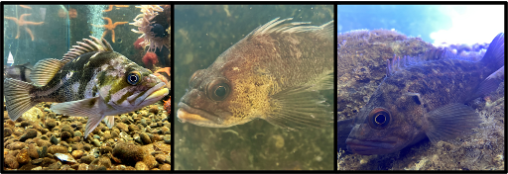
Even with improved sampling methods, hybridization was still found only in Puget Sound individuals of the closely related copper, quillback, and brown rockfish species. Nearly all of the rockfish samples tested had a mix of two of these three species. For example, Hauser reflects that a copper rockfish could have 95% copper and 5% quillback DNA. Thanks to access to the entire genome sequencing, this work could pick up nuances that previous research could not.
Wray’s work determined that hybrid rockfish tend to occur, and remain, in south Puget Sound. Hauser suggests that there are a few theories as to why hybrids occur only in Puget Sound: “If one species doesn’t find a mate [of their own species], they may mate with the more common species.” Another possibility is that rockfish habitat on the Pacific coast looks very different from Puget Sound, namely in that Puget Sound has more limited rocky reefs that rockfish tend to prefer. “That might mean that all the species come together and are sympatric, living in the same habitat,” Hauser explains. “On the coast, it is thought that the quillback lives deeper [than copper rockfish], whereas in Puget Sound they are pushed together.”
Hauser and his collaborators are looking forward to using these and other new genetic techniques to learn more to support rockfish recovery in Puget Sound. He is interested in looking at mitochondrial DNA — DNA passed solely from mother to offspring — to shed light on more recent hybridization events. “Essentially, you have a bunch of species that hybridize and introduce genetic variability into other species. It might actually be useful for adaptation to environmental change. That’s the next project we want to do,” Hauser says.
Rockfish as a group are found throughout Washington, yet the many species and different life history patterns complicate management practices. This research demonstrates that Puget Sound rockfish recovery may need to occur on a species-by-species basis, a finding vital to developing management strategies for the recovery of targeted species.
To learn more about this project and other Washington Sea Grant funded work, explore the Funded Research Database on the WSG website.